

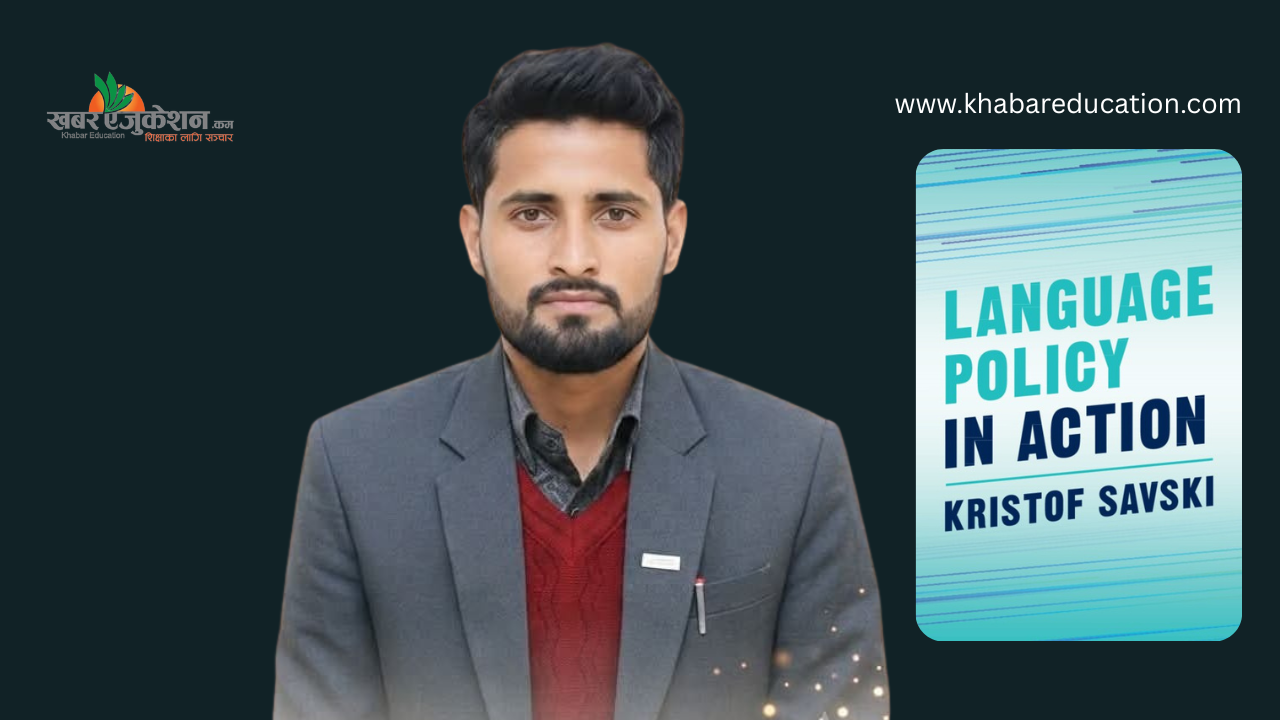
Kathmandu/25 July -Bibliographic Information
Kristof Savski. Language Policy in Action. Cambridge: Cambridge University Press, 2025. First edition. Pp. 214.
Language policy is about power and identity. It is about how people use language to control others. Kristof Savski’s Language Policy in Action is an addition to the field of language policy studies.
In this book, Kristof Savski challenges the way we think about language policy. He says that language is a part of our life and that trying to control it is more than just language. It is about issues like migration, education, class and race. This book is about how people in institutions and communities try to control the language of others.
Kristof Savski combines ideas from fields like sociolinguistics, discourse analysis and critical theory to come up with new ideas about language policy. He says that we should not just look at language policy in terms of languages like English or Thai but in terms of how people manage discourse. Kristof Savski argues that language policy is not about language but also about identities, ideologies and relationships. This makes the book very relevant to our world today where language is connected to politics, education, migration and social inequality.
One of the book’s strengths is its approach to language and power. Kristof Savski says that language policies are never neutral and that they usually represent the interests of groups. He looks at language policies that silence some voices and perpetuate inequalities. At the same time, he emphasises the role of individual agency and resistance. This makes the book more convincing because it does not portray people as recipients of policy decisions.
The book is organised around five actions in language policy: constructing, debating, interpreting, enforcing and resisting policies. Kristof Savski’s framework is original because it shifts attention from policy documents to the actions surrounding them. Policies are not just texts, but ongoing processes formed by institutions, communities and individuals. This focus on action allows readers to see language policy as something that is always happening in schools, the media, governments, online spaces and everyday interactions.
The book also includes case studies from countries like Slovenia, Singapore and Thailand. These examples show how language policies work in practice. For instance, Kristof Savski discusses how media debates in Singapore reflect ideological struggles over identity and multilingualism. He also examines how the depiction of English-language learning in Thailand relates to success and modernisation. These examples make the theoretical considerations more practical and easier to understand.
Another strength of the book is Kristof Savski’s use of evidence. Policy documents, interviews, ethnographic observations, media texts and online discussions support his arguments. The evidence is diverse and relevant. The book’s strength is also found in its approach linking language policy studies with broader discussions in sociolinguistics and applied linguistics. Kristof Savski develops his theory by critically engaging with influential scholars like Bernard Spolsky and Elana Shohamy.
The book, focused on discourse-based methods, makes a major contribution. Kristof Savski argues that by seeing policies as fixed governmental choices, researchers should examine how policies are understood and enacted in contexts. This methodological stance is particularly useful for researchers working in societies because it recognises the complexity and diversity of language practices. Kristof Savski’s framework offers insights into the relationship between language and social power, especially in countries like Nepal where language, identity and education are politically sensitive issues.
The book is written in an organised style. Kristof Savski breaks down theories in a careful way and backs them up with real-world examples. The book is organised logically, with each chapter covering a policy action. This organisation helps the reader keep track of the development of ideas in the text. Some sections are conceptually dense, such as those on critical discourse theory and semiotics. Those unfamiliar with sociolinguistics or critical theory may find the discussions to follow. However, the difficulty is tempered by the clarity of examples and strong organisation of the chapters.
The book is highly impressive. It has a few limitations. Most of the case studies are from Southeast Asian contexts. The book would have been globally relevant if it had more examples from South Asia or Africa. Also, the theoretical discussions are rich and detailed. Some readers might want more practical recommendations for policymakers and educators. It’s more about analysis than policy prescriptions.
Nevertheless, Language Policy in Action is a scholarly work that makes an important contribution to language policy studies. Kristof Savski does a good job showing that language policy is not just about regulating language but about managing discourse, identities and relations. His action-oriented framework challenges understandings of language policy and invites readers to critically reflect on the relationships between language, power and society.
This book is effective and fruitful for students, researchers, teachers and policymakers interested in sociolinguistics, applied linguistics, multilingualism and critical pedagogy. The book is innovative, methodologically useful and intellectually structured. It provides insights into issues of language, identity and inequality in modern societies. Kristof Savski’s work is sure to be a test in the field of language policy for years to come.
(Reviewer : Jeevan Regmi is an MPhil English Language Education scholar at the School of Education, Kathmandu University, Nepal. Serving as the principal of Shree Sharada Secondary School, his academic interests include technology integration in the language classroom, AI in the professional development of teachers, as well as enhancing multimodal technologies in ELT. Email: [email protected])