

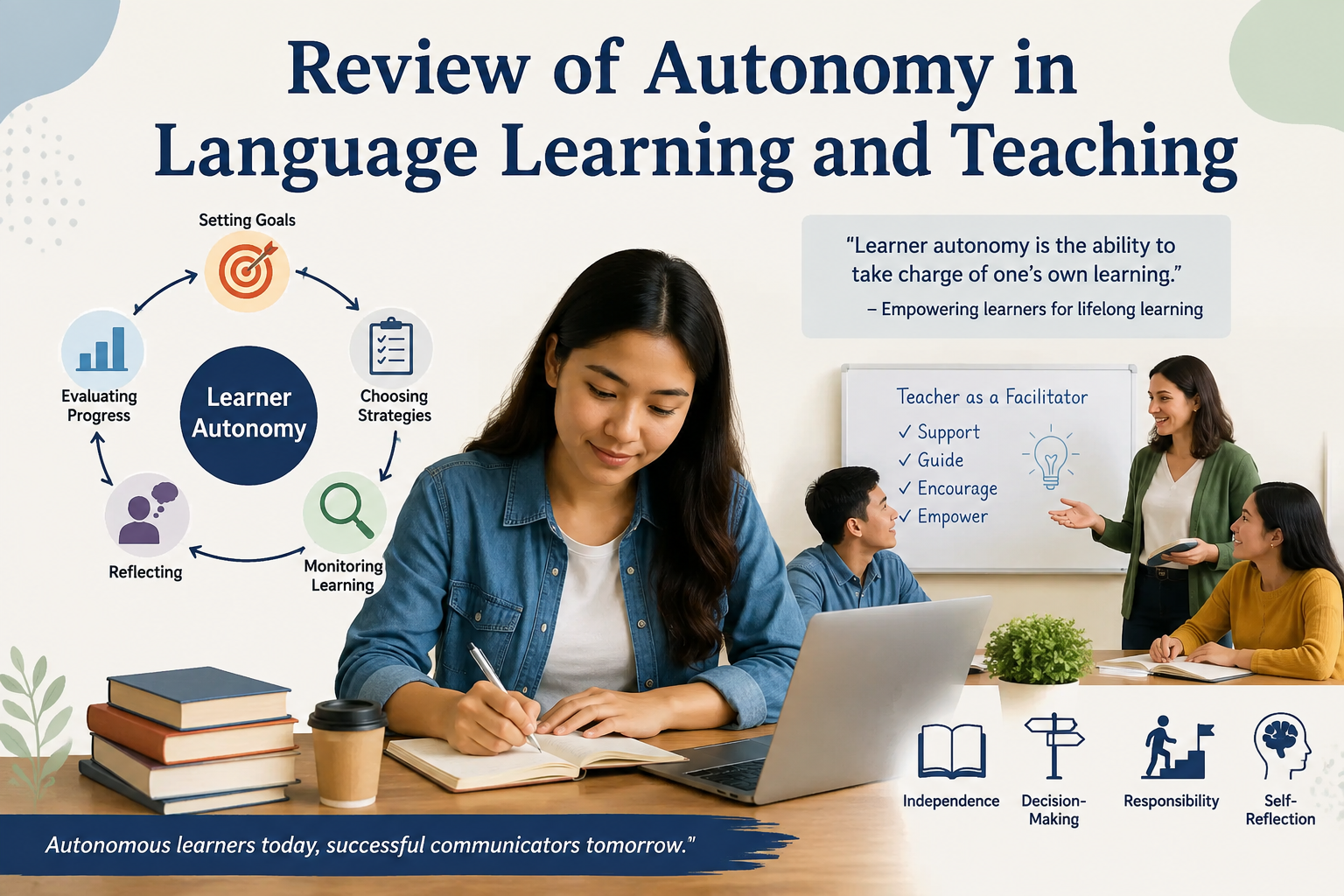
Kathmandu/1 September- Introduction : This book review critically examines the volume’s pedagogical implications, methodological choices, transferability of the book’s arguments, and central thematic concerns. The edited volume was published in London in 2018; this edited volume remains relevant to 21st-century language education due to its reconceptualisation of learner autonomy that aligns well with current theories on socially situated, collaborative, and technology-supported learning. The title of the edited volume is Autonomy in Language Learning and Teaching: New Research Agendas. The volume was edited by Richard Smith, Naoko Aoki, and Alice Chik. It presents autonomous learning as self-directed, purposeful, and culturally informed, supporting learners in taking responsibility for their language learning. This book’s publisher is Palgrave Macmillan. The book has been published in both hardcover and electronic formats. The challenges resulting from outside triggers make teachers less focused on their tasks and less productive in the classroom.
This book is more concerned with encouraging student autonomy in settings with inadequate assets than with supporting circumstances with an abundance of comforts. Students, therefore, grow at their own pace, discovering themselves through introspection.
Across its chapters, the book identifies many challenges that influence the development of learner autonomy, including how different regions use different teaching methods, the scarcity of resources, how people neglect to take part in group projects, and how there are not enough ideas or educational protocols. It also highlights the nuances and complexity of both teachers and learners.
Contemporary learners and students will use digital tools to support their learning (Yalçın, 2024; Noori, 2025). However, learning is not limited to digital spaces. Story development is demonstrated in the classroom using written material and visuals on the walls. Along with these resources, students can engage in interactive activities and write as part of scenario-based lessons that accentuate language and phrase building. In addition, digital tools such as MIM (Mobile Instant Messaging) can also be used in ELT (English Language Teaching) to support language acquisition with the right software. When taking the initiative or making judgments, researchers benefit from both macro- and micro-level perspectives. The use of audiovisual resources can enhance people’s ability to learn and hone performance.
In the case of autonomy, it was clarified that critical pedagogy supports students in stimulating and questioning the practices and norms to which they are subjected. While some people learn best by listening, others learn best by speaking, reading, and writing. Similarly, all strategies and policies should be regularly and consistently validated against several shortcomings in the language learning process: linguistic damage, communication hurdles, and language barriers may be the reasons for these challenges. It would be beneficial to integrate ICT technologies into teaching and learning progressions. Learner autonomy in language education is associated with active participation, metacognition, emotional, social, and collaborative dimensions (Wang et al., 2024; Liu et al., 2026). It has a highly significant concept of responsibility and self-directed learning, actively selecting strategies and writing beyond the physical boundaries of the classroom. Learner autonomy can also contribute to lifelong learning and provide a framework for addressing the changing linguistic and professional demands in language education over the past four decades. In the present educational landscape, autonomy can empower learners, reflect outcomes, and closely relate to the movement away from teacher-dominated classrooms.
So, contemporary approaches recognise purposeful action, interaction, and problem-solving within learning activities and educational contexts. Critical consciousness, self-regulated development, and commitment to continuous learning are due to learner autonomy (Treesattayanmunee & Baharudin, 2024; Cao & Pho, 2025; Betancor-Falcon, 2023). Similarly, learner autonomy is a central principle for reflective practice and a priority for fostering agency to enable learners to pursue knowledge independently. Modern scholarship conceptualises learner autonomy as a dynamic process and the ability to make decisions about their learning. Therefore, it requires quality communication with teachers, peers, and communities. Cultural expectations, technological transformations, and autonomy have fluctuated according to knowledge and motivation, and possess different degrees of institutional power. Earlier approaches emphasised self-directed learning, but a critical lens offers valuable insights into learners’ willingness to participate in learning.
This book represents active engagement, identity construction, and bridges perspectives on how autonomy can be understood and practised in recent contexts. It encourages readers to scrutinise fluidity and complexity, and draws attention to emerging questions. Autonomy explores unexplored areas and supports a contextualised approach to linguistic development. The editors’ inclusion of an interdisciplinary field of inquiry towards cultural norms, social, and classroom practices remains responsive to transformations in language education. Autonomy navigates deep, technologically rich environments and incorporates trust, a valuable foundation for research. The editors’ notion challenges rigid syllabi, hierarchical structures, and views autonomy as multilingual, migratory, and relational in the evolving dimension of language education. The experiences of learners constitute linguistic proficiency, authority, individual responsibility, and more, grounded in a multidimensional understanding of autonomous learning.
The book reveals productive spaces of contextual sensitivity, practical orientation, interdisciplinary approaches, and valuable contributions to contemporary discourse for language learners in the 21st century. Therefore, this review aligns with the expanding scholarship on technology-enhanced learning in African higher education, access and inclusion, contextual negotiation, intellectual discourse, challenges, metacognitive awareness, and more are articulated in modern digital learning environments (Ambinintsoa & Castro, 2024; Nduwimana & Ndoricimpa, 2023). In the end, the book challenges the autonomy framework, educational approach, mechanism, agenda, and dimensions in language exercise. The essence of interactive learning is teamwork, involvement, and communication. Creating language to facilitate sincere and meaningful communication. Teaching literature has its challenges, including the incorporation of literacy and the consideration of political, historical, social, and geographic factors.
Overview of the Book
Learner’s influence on institutional opportunities and autonomy-oriented policies in classroom realities. The editors present autonomy as a socially embedded, technologically mediated concept and reconceptualise the learner as a context-dependent process concerning educational equity. Similarly, the volume demonstrates that learners do not develop autonomy in isolation. Therefore, researchers and teachers need to examine autonomy in relation to social practices, and virtual classrooms allow learners to communicate beyond conventional classroom boundaries (Lo, 2024; Motzo, 2025). Learning experiences would be evaluated, and sociocultural forces collectively shape learners’ autonomy in building flexibility, trust, and fruitful participation. This volume connects teachers, educators, learners, and researchers, and underscores learner-centred education by connecting creativity, critical thinking, and developing identities as competent language learners. The book is structured in interconnected chapters on digital technologies, multilingualism, teacher identity, and professional autonomy, drawing evidence from diverse educational settings across Asia, Africa, Europe, and other regions.
The volume presents teachers as crucial architects of autonomy, and they can function as reflective practitioners who nurture autonomous learning. The chapters in this book provide a transformative view of the role of digital technologies in this day and age. It highlights virtual classrooms, mobile applications, and online communication platforms, and portrays technological tools to address challenges in language learning and teaching. This book teaches us to become innovative problem-solvers, peer tutors, and to extend the possibilities for autonomous learning in local environments as well. Furthermore, preparation can help teachers develop context-sensitive approaches and acknowledge community experiences in contextually grounded pedagogical settings with specific educational needs and practices (Zhang & Peng, 2024). Overall, the book establishes the dynamic pattern of language learning, bridges theory, and reconstructs it in changing educational environments.
Critical Analysis of the Book
This book advances the argument that autonomy has been completely changed from the traditional view of autonomy. The strength of this book is its context-sensitive approach and its capacity to act purposefully within complex social contexts and social relationships. The idea of multiculturalism, digital, and understanding of how agency is constructed through negotiation and independence has been conceptualised. The authors’ fundamental assertion captured the spirit of autonomy in language learning and teaching. They favoured a broader definition of autonomy that considers competition, cooperation, and conflict. Along with activities that centre on students, resources, curriculum, and learning pace, it stresses the importance of excellent student connections. The author highlights how important it is to use various digital tools and gather empirical knowledge. The writers also develop the concepts of application, extent, and consequences.
Certainly, progressive teaching strategies include carefully structuring learning activities, providing opportunities for students, analysing their spatial scale, applying knowledge through collaborative group activities, structuring the information flow, and ending with a group exercise (Kerrigan & Kwaik, 2024; Driessen et al., 2024; Bohara & Awasthi, 2026). Thus, accountability, incentive, collaboration, and self-evaluation are all integrated by an autonomous learner. A focus on social dynamics, communications, identities, agency, and diverse digitally-mediated learning contexts is very significant in the research. An emerging autonomy is an appropriate approach in that it takes into consideration the emotional, cognitive, and cultural aspects of learning (Chen & Liu, 2025; de Vrind et al., 2024; Huang et al., 2024). Nevertheless, teachers develop students by providing them with help, guidance, supervision, and feedback. Social relationships, worldviews, languages, previous experience, alliances, and other aspects are connected with emotions. Emotional labour also reflects power relations and informal rules in the organisation. Professional vulnerability of teachers and the dangerous social stigma they suffer from in Hong Kong and in China as a whole have been collected from two studies in this chapter.
Over three months, the researcher gathered 8398 threads of online talks with 44,645 responses. The authors’ presentation does not contain any discrepancies or disputes, but it does draw attention to certain difficulties, like inadequate compensation, a heavy workload, and few opportunities for speech practice. Managing a large class of pupils can be challenging. Teachers receive extremely low pay, which deters people from pursuing careers in education. This book focuses on comprehensively recording complex cultural components such as language, religion, beliefs, customs, and values, while remaining sensitive to cultural differences and maintaining anonymity through document analysis.
The writers also use narratives from personal experience, pragmatic research, and case studies. It comprises meticulous observations and actual obstacles to student autonomy in the classroom. The individual learner’s capacity to create dialogic, socially relevant, phenomenon-based, teacher-intervention-free responses to multifaceted phenomena. This book offers intercultural competence, linguistic repertoires, and ethical awareness by embracing autonomy in teaching and learning. A notable contribution of the book lies in real-world learning environments and the reciprocal relationship between theory and practice. It tells us that autonomy can be contextually grounded, critically nuanced and appropriately scaffolded to support learner responsibility. The inclusion of case studies from India, China, Pakistan, and various African contexts broadens the cultural scope, prompting teachers to critically reflect on pedagogical practices, collective responsibility, and the positioning of the teacher as a facilitator. The book avoids a one-size-fits-all model and informs the spectrum of language in educational contexts, fostering educational diversity. The main feature of this book is social situatedness and independence within the broader ecosystem of agency. The scholarly contributions are the conception of autonomy, the use of context-responsive pedagogy, and encouraging researchers to study autonomy from the professional perspective. It calls for dynamic and productive future research areas.
Evaluation of the Book’s Contribution and Significance
Chik et al. (2018) contribute to the existing body of knowledge on autonomy of learners by moving beyond simple definitions of the concept, which are strictly individualist. The autonomy of learners is described in the text as socially, culturally, institutionally and technologically contextualised. This means that the autonomy of learners is achieved through interaction in particular social relationships and learning contexts. The book contributes to the existing literature by exploring such notions as teacher autonomy, group learning, digital practice, and low-resourced settings in order to show that there is no universal way of achieving autonomy. Although this book was published a few years ago, it is still relevant to modern education because of the emergence of online, hybrid, and AI-assisted learning environments (Chen & Liu, 2025). The book evaluates educational ideologies and suggests autonomy in reciprocal interaction. The volume connects learner agency with identity formation and critical reflection, and the discussions establish a conceptual foundation to reflect broader perspectives. This book is useful for scholars working in the field of learner autonomy research. This book will be quite useful for scholars, educators, and policymakers in the field of autonomy in language education.
Through case studies, individual students can thoroughly understand how learner autonomy is guided by communicated learning strategies to obtain their specific learning goals. One of the major advantages of this book is the well-balanced interplay between theory, research, and pedagogical practice. In contrast to remaining within the scope of theoretical considerations, the authors give practical examples of classroom practices and research, which show that the autonomy of both learners and teachers can be developed in different contexts. Discussion of such themes as teacher agency, reflective practice, digital learning, multilingualism, and institutional constraints broadens the scope of research into autonomy and provides practical guidelines for establishing more learner-centred and diverse classrooms.
In summary, this edited book is an excellent scholarly contribution to the fields of applied linguistics and language education. The conceptual rigour, empirical robustness, international scope, and practical utility of this book will make it a highly useful reference for academics, graduate students, teacher educators, language teachers, and policymakers alike. In an attempt to get the reader convinced of looking at autonomy as an interactive process, this book not only contributes theoretically but also educationally.
Conclusion
The book holds immense importance in making contributions towards the field of learner autonomy research in modern times due to the fact that it combines theory, practice, and pedagogy within itself. It has highlighted many important dimensions of learner autonomy, including agency, reflection, cooperation, e-learning, professional development, and educational equity. Although there could be improvements in certain critical dimensions of the book, the book does hold a good base for understanding autonomy.
About the Author
Nirajan Bohara is a Lecturer and Visiting Assistant Professor at Kathmandu University with 11 years of experience in education. His academic interests include critical pedagogy, teacher identity, learner autonomy, collaboration, literature, and teacher education. He is a life member of NELTA and has presented research at national and international conferences. In 2026, he was recognised as a High-Performing Alumnus of the Professional Development for Teacher Trainers program offered through the Online Professional English Network (OPEN) by Arizona State University and sponsored by the U.S. Department of State and FHI 360. His professional work focuses on digital pedagogy, responsible AI use, reflective teaching, professional development, and innovative approaches to English language education.
ORCID ID: https://orcid.org/0009-0004-6565-1004
References
Ambinintsoa, D. V., & Castro, E. (2024). Self-regulation to develop autonomy in language teacher education: Two case studies in an EFL Malagasy context. In N. Thomas, J. Schneider, & S. Zhou (Eds.), Qualitative research on language learning strategies and self-regulation (pp. 416–440). John Benjamins Publishing Company. https://doi.org/10.1075/aila.24023.amb
Betancor-Falcon, S. (2023). Toward a coherent critical theory of learner autonomy in language learning: Exploring its political implications in higher education and limitations in the literature. Educational Philosophy and Theory, 55(13), 1550–1561. https://doi.org/10.1080/00131857.2023.2219842
Bohara, N., & Awasthi, J. R. (2026). Role of collaboration in English teacher education: A narrative inquiry. Exploration अन्वेषण, 4(1), 144–160. https://doi.org/10.3126/exploration.v4i1.88734
Cao, D. T. P., & Pho, P. D. (2025). Relationship between learner autonomy and academic performance. Issues in Language Studies, 14(2). https://doi.org/10.33736/ils.8441.2025
Chen, L.-M., & Liu, C. (2025). Critical learner autonomy in the digital language learning context. TESOL Journal, 16(2), e906. https://doi.org/10.1002/tesj.906
Chik, A., Aoki, N., & Smith, R. (Eds.). (2018). Autonomy in language learning and teaching: New research agendas. Palgrave Macmillan. https://doi.org/10.1057/978-1-137-52998-5 de Vrind, E., Van Hout, R., & Verspoor, M. (2024). Improving self-regulated learning of speaking skills in foreign languages.
The Modern Language Journal, 108(4), 1041–1063. https://doi.org/10.1111/modl.12953 Driessen, E. P., Wilson, A. E., Hall, I., Brewer, P., Odom, S., Ramsey, S. B., Wood, S., & Ballen, C. J. (2024). Group work enhances student performance in biology: A meta-analysis. BioScience, 74(3), 207–217. https://doi.org/10.1093/biosci/biae001
Huang, L., Al-Rashidi, A. H., & Bayat, S. (2024). Teacher support in language learning: A picture of the effects on language progress, academic immunity, and academic enjoyment. BMC Psychology, 12, Article 124. https://doi.org/10.1186/s40359-024-01602-2 Kerrigan, J., & Kwaik, J. (2024). Investigating the effects of active learning pedagogies implemented in the active learning classroom. College Teaching. Advance online publication.
https://doi.org/10.1080/87567555.2024.2399624 Liu, A., Abdullah, A., & Dong, H. (2026). Dimensions of English language learner autonomy assessment: A systematic review of what is there and what is missing. Frontiers in Psychology, 17, 1711599. https://doi.org/10.3389/fpsyg.2026.1711599 Lo, N. P.-K. (2024).
Cross-cultural comparative analysis of student motivation and autonomy in learning: Perspectives from Hong Kong and the United Kingdom. Frontiers in Education, 9, 1393968. https://doi.org/10.3389/feduc.2024.1393968 Motzo, A. (2025). A netnographic study of online informal language learning collaborations [Doctoral thesis, The Open University]. Open Research Online. https://doi.org/10.21954/ou.ro.00106378 Nduwimana, A., & Ndoricimpa, C. (2023).
The use of ICT tools in learning English autonomously. JOLLT Journal of Languages and Language Teaching, 11(4), 699–710. https://doi.org/10.33394/jollt.v11i4.8608 Noori, A. (2025). Digital technologies and self-regulated language learning: A systematic review. Journal of Social Sciences – Kabul University, 8(1), 243–263. https://doi.org/10.62810/jss.v8i1.323 Treesattayanmunee, P., & Baharudin, S. M. (2024). Learner autonomy and interaction in English language learning among Thai EFL undergraduate students.
LEARN Journal: Language Education and Acquisition Research Network, 17(1), 393–415. https://doi.org/10.14456/learnjournal.2024.17 Wang, X., Zhang, Q., Chen, H., Neitzel, A. J., & Davis, M. H. (2024). The effects of language learning strategy instruction on college students’ English achievement and learner autonomy in mainland China: A meta-analysis. International Journal of Educational Research, 127, 102442. https://doi.org/10.1016/j.ijer.2024.102442 Yalçın, C. (2024).
Technology-supported self-regulated language learning: A systematic review. İnönü University Journal of the Faculty of Education, 25(2), 461–480. https://doi.org/10.17679/inuefd.1396935 Zhang, J., & Peng, Y. (2024). Unlocking teacher agency for professional learning through connection-building: Evidence from a professional development program on China’s Standards of English Language Ability. The Asia-Pacific Education Researcher, 33(6), 1515–1523. https://doi.org/10.1007/s40299-024-00914-6