
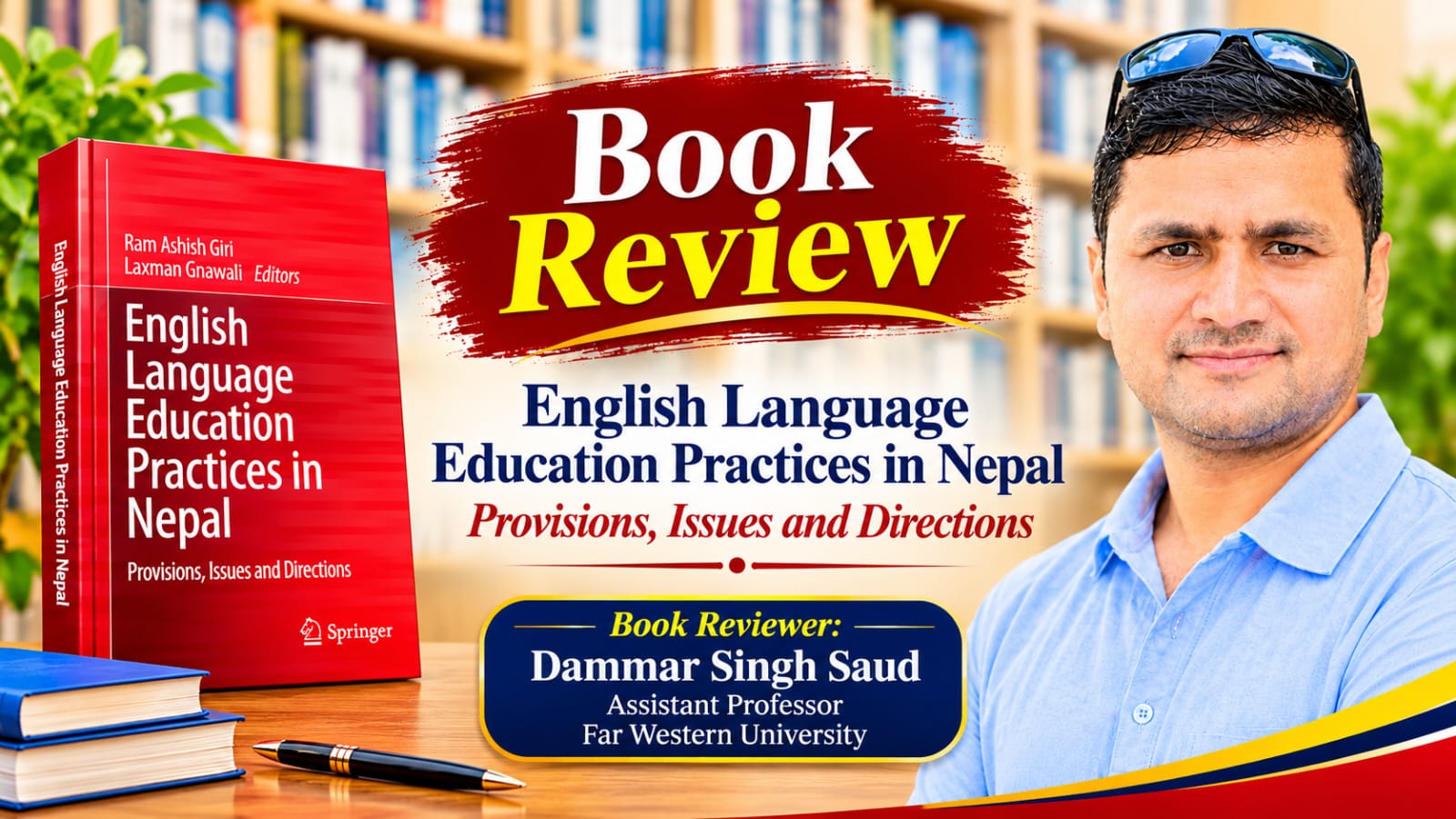
Kathmandu, 16 November – Introduction : English language education in Nepal has undergone substantial transformation in response to changing educational priorities, globalisation, technological advancement, socioeconomic aspirations, and the country’s increasingly complex multilingual realities. English has emerged as a significant resource in education, employment, international communication and social mobility in Nepal, but its role in the educational and linguistic context is debatable. Language policy, the medium of instruction, pedagogy, unequal access to educational resources, teacher preparation, and the conservation of indigenous languages remain critical issues in discussions about the future of English language teaching. “English Language Education Practices in Nepal: Provisions, Issues and Directions”, edited by Ram Ashish Giri and Laxman Gnawali, is a timely and significant contribution to the scholarship of English language education in Nepal in a multifaceted context.
This edited book, published in 2026 by Springer Nature Singapore, is a compilation of 22 chapters by well-known and emerging scholars from Nepal and abroad. It offers a comprehensive overview of the history of English language education in Nepal, current experiences in English language teaching, institutional arrangements, pedagogical issues and prospects. The book does not focus only on the traditional approach to English language teaching but on the wider educational, sociolinguistic, technological, political, cultural and professional aspects of English language education. Its main focus is on the conceptualisation, implementation, experiences and negotiations of English language education in Nepal’s unique educational and multilingual context.
One of the most significant strengths of the book is its effort to bridge the gap between the international advances in English language education and the realities of the classroom and educational system in Nepal. The editors have gathered together theoretical discussion, empirical study, literature-based analyses and pedagogical reflections to offer a comprehensive view of the opportunities and challenges facing the field. The book is a much-needed one as it challenges the notion that models of ELT that have been developed in other countries can be directly imported to Nepal without taking into account the linguistic, cultural, institutional and socioeconomic context in Nepal.
Organisation and Scope of the Book
The volume is divided into five thematic parts, followed by an afterword and an introduction to the volume. This organisation offers a logical movement from pedagogic and curricular issues to language skills, technological innovations, students’ well-being and teacher professional development.
The first chapter, titled “English Language Education Practices in Nepal: Existing Constraints and Future Challenges,” by Ram Ashish Giri and Laxman Gnawali, provides the intellectual ground of the present book. It critically reviews the historical evolution and current status of English in Nepal, the inconsistencies in English education policies, the Anglocentric orientation of education, differences in access to quality English education and the evolving objectives of English learning. Of particular interest is the discussion of English as an alternative language in Nepal, that is, a language that is not foreign, but a second language. The chapter also presents the theoretical and ideological discourses on English language education, which involve language hegemony, language ecology and politico-economic inequality. It offers a good framework for the contributions that follow.
Part I, “Pedagogical Approaches to Classroom Instruction”, has six chapters on plurilingual education, critical thinking, deeper learning, online classroom management, English as a medium of instruction (EMI) and locally relevant instructional materials. In Chapter 2, Giri suggests a plurilingual education model for the creation of contexts, which sees educational policies acknowledging and building upon the learner’s preexisting linguistic repertoire, instead of assuming that a select few predetermined languages are more important. The language diversity aspect of this contribution is relevant, especially in Nepal, where it is an important educational resource. Daya Ram Gaudel and Laxman Gnawali respectively discuss critical thinking and deeper learning in the English language classrooms in chapters 3 and 4, while Sunita Swar Suri discusses the integration of critical thinking and deeper learning in the social studies classroom. The talks reflect the need for pedagogical approaches that are reflective, interactive and learner-centred. Chapter 5 by Janaki Sharma shows classroom management strategies, and Chapter 6 by Dipak Prasad Mishra examines how to apply EMI in public schools. Chapter 7 by Sagar Poudel highlights the didactic importance of local and cultural teaching resources. Together, these pieces support pedagogical approaches that respond to learners’ linguistic, cultural and educational contexts.
The second part, entitled Teaching of English Language Skills, contains seven chapters concerning literacy, writing, reading, speaking and listening. In the secondary-level English curriculum, Jeevan Karki’s discussion on critical literacies and multiliteracies looks at the relationship between curriculum, language and what the demands of contemporary literacy are. Kashi Raj Pandey, Krishna Dutta and Bharat Prasad Neupane discuss transformative learning activities to develop writing skills, and Madhu Neupane Bastola examines contradictions in postgraduate thesis writing and supervision using the lens of Cultural-Historical Activity Theory. Jagadish Paudel looks at the difficulties of undergraduate writing instruction, emphasising students’ language backgrounds and institutional limitations. These are some of the challenges tackled by Basanta Raj Dhakal, who looks at problems in reading; Gambhir Bahadur Chand, who investigates the marginalisation of speaking skills in Nepalese schools; and Annu Rana, who talks about the pedagogy of listening. These chapters in total reject the common approach in the traditional grammatically oriented grammar-reader-writer examinations, where reading and written work are emphasised in line with grammatical knowledge.
Three contributions in Part III, “Technology in English Language Education,” explore the increasing role of digital and mobile technologies in the field of English language education and learning. The metasynthesis by Suman Laudari explores the status and practices of integration of ICT in EFL education at the secondary level in Nepal, with a specific focus on teacher agency and opportunities and constraints of using ICT. The chapter on “Digital Practices in English Language Education in Nepal: Lessons from the DigCompEdu Framework” by Dammar Singh Saud examines the experiences of ELTEs in introducing digital technologies in their university classrooms. The chapter focuses on digital pedagogical practices, competencies of educators, institutional support and challenges related to the use of technology in education, using the European Framework for the Digital Competence of Educators as a framework. In this systematic review, Krishna Kumari Upadhayaya explores the potential of Technological Pedagogical Content Knowledge (TPACK) and Universal Design for Learning (UDL) in the professional development of English language teachers during online teaching. The three contributions all show that the integration of technology into lessons and learning is a complex process that cannot be accomplished simply by providing students with access to digital devices, but rather necessitates the building of the appropriate competency, pedagogical awareness, institutional support, and equitable technological infrastructure.
Part IV, “Anxiety and Well-Being in English Language Education,” focuses on two chapters that discuss the psychological and professional aspects of English language education. Hiralal Kapar and Samikshya Bidari explore the factors related to the foreign language anxiety of students in Mahottari District with a specific focus on English exams. They address issues that bring the subject of fear of examination, psychological pressure and the impact of anxiety on students’ language learning experience to the fore. Surendra Prasad Bhatt and Laxman Gnawali explore how other factors influence teachers’ well-being, such as the connection between teachers’ professional satisfaction, workload, psychological well-being, institutional expectations, and their ability to maintain effective classroom practices. These contributions are significant since they expand the definition of English language learning beyond a curriculum and instructional approach and into the emotional and psychological needs of students and teachers.
Part V, “Teacher Professional Development,” is made up of two chapters that are directly related to teacher learning and professional development. Binod Duwadi discusses professional development and sharing success stories amongst rural school teachers in Nepal. The chapter illustrates how the practice of collaborative learning, professional dialogue, mentoring, and sharing effective teaching experiences can help new teachers and alleviate professional isolation. Nani Babu Ghimire’s chapter examines professional development policies and practices in the community schools teaching English as a medium of instruction. It highlights the significant mismatch between the implementation of EMI policies and preparation and support for teachers. The contributions highlight the significance of ongoing, contextually relevant, collaborative, and hands-on professional development. Last but not least, Govinda Raj Bhattarai’s afterword, “A Fresh Package of ELT World Discourses Substantiated for the Nepalese Contexts,” is a reflection on the shifted role of English in Nepal and its position in the international debates on language, identity, pedagogy, and educational transformation.
Major Intellectual Contributions and Critical Evaluation
The volume’s one of the major strengths is the contextualisation of English language education in a multilingual and multicultural context in Nepal. In challenging this belief, the book posits that the norms, pedagogical traditions, and pedagogical materials of traditionally dominant English contexts should not be the sole basis for guiding the teaching and learning of English in literature taught in other languages. Rather, it invites teachers and policymakers to understand the authority and legitimacy of local languages, cultures and contextually relevant pedagogical approaches. In this, Giri’s elaboration on plurilingual education has special relevance. The chapter separates the individual plurilingual repertoire from societal multilingualism, thus offering a conceptual framework for thinking about language education policies in a country with significant linguistic diversity. It places emphasis on respecting the learners’ own language, which reflects a challenge to language hierarchy, and to the English-only policy.
The other important contribution of this book is its critical examination of the involvement of English, educational opportunity and social inequality. This volume celebrates the fact that English has emerged as an important language and educational asset in Nepal. The provision of acceptable quality English language teaching is, however, not equally available across geography, socio-economic groups and educational institutions. The difference between private, English-medium schools and public or community schools highlights the ways in which English can be a means of social mobility, as well as a means of reproducing existing inequalities. Two chapters on EMI are of special importance in the area of this paradox. They show that English as a medium of instruction, when not well prepared by the teacher, supported by the right kind of instructional materials and institutional support, can be a threat to the quality of education. The book consequently makes a valuable use of the distinction between the desirable and the effective in policies for the promotion of English-medium instruction.
The volume is also a thought-provoking contribution to the debate surrounding learner-centred and context-responsive pedagogy. It includes the elements of critical thinking, deeper learning, local instructional materials, multiliteracies, and language skills, which align with a current trend in developing learners’ communicative, analytical, creative, and reflective abilities. For example, the chapter on graphic organisers in Chapter 4 demonstrates the potential of relatively easy-to-access instructional materials to enhance engagement with content matter. Likewise, the focus on locally and culturally relevant materials in Chapter 7 raises questions about a reliance on imported instructional materials that may not be relevant to students’ lived experiences. These conversations can be helpful when used by teachers in public and community schools with fewer resources available for use.
One of its key assets is the incorporation of all four language skills, as well as critical literacies and academic writing. The chapters on reading, writing, speaking and listening deal with a perennial issue in the field of English language learning in Nepal, a neglect in teaching the language and not enough emphasis on the development of communicative competence. This is particularly important in examination-driven teaching and learning systems where written work is more valued than oral work. Similarly, the chapters on undergraduate writing and thesis supervision go beyond the school level of language study to the academic English needs of higher education. The book integrates these various aspects to provide a more complete picture of language development in the various levels of instruction.
Another great addition is the treatment of digital transformation. The pandemic revealed the inadequacies of traditional teaching arrangements and the shift to online and technology-based learning. The technology section wisely challenges the notion that technology is a magic bullet for improving learning. Rather, the contributors emphasise the need for teacher agency, digital literacy, pedagogical capacity, institutional structures, and teacher learning. It is very useful to use the DigCompEdu framework to establish a linkage between the digital practice in Nepal and an internationally recognised framework for the digital competence of educators. In parallel, the consideration of TPACK and UDL suggests the possibilities of combining content knowledge, pedagogical knowledge, technological knowledge and inclusive instructional design. The contributions provide valuable insights for universities, teacher education institutions and policymakers aiming to enhance the digital teaching and learning environment.
Also significant is the focus on feelings and mental health in the teaching of English. When issues of curriculum, methodology and assessment dominate the conversation, foreign language anxiety and teacher well-being are often overlooked. The editors acknowledge that while instructional skills are important, psychological safety and emotional support, professional satisfaction, and institutional working conditions are also key factors in effective teaching and learning. An examination-related anxiety study can help to identify the negative impact on learners’ confidence and performance that can occur in the assessment environment. As is similarly reported in the chapter on teacher well-being, teachers’ excessive workloads, too many professional obligations and poor institutional support have repercussions. One of the major strengths of this collection is the broader understanding of the quality of education.
In a way, the final section is the most directly relevant to teacher educators and professional development researchers. Others emphasise the need to rethink the traditional training-based methods for EMI schools in the chapters on mentoring, sharing of success stories, and professional development in EMI schools. The chapters on mentoring, sharing of success stories, and professional development in EMI schools emphasise the need to rethink the traditional training-based methods. They propose that teacher learning be ongoing, collegial, contextually grounded, and responsive to teachers’ professional needs. The role of mentoring in Duwadi’s discussion highlights the importance of professional relationships, peer learning, and psychological support, especially in rural schools. The study by Ghimire reveals the repercussions of implementing educational reforms without properly training teachers to adopt them. These chapters together further underscore the need to view policy implementation and teacher professional development as a single process, and not as distinct problems in education.
Methodological and Scholarly Strengths
Another good aspect of the volume is its methodological diversity. It has a variety of research methods such as qualitative case studies, phenomenological studies, narrative research, document analysis, thematic analysis, metasynthesis and systematic literature reviews. Data collection tools are in-depth interviews, classroom observation, field notes, document reading, questionnaires, and reflective accounts. This diversity allows for a comprehensive discussion of English language education from several points and with several viewpoints in the educational system.
It is very helpful to have both empirical investigations and conceptual discussions. Some chapters discuss the teachers’ and students’ experiences in specific educational contexts; others discuss more general questions of theory and policy. The juxtaposition enables readers to gain insight into not only the theoretical basis for modern English language learning but also the actual problems faced by English language teachers in their classrooms. Contributors from diverse institutional and international backgrounds also add to the conversation by introducing locally situated experience and perspectives from the scholarly literature.
The volume is underpinned by a wide range of literature in the fields of applied linguistics, language education, educational technology, sociolinguistics, teacher education and educational psychology. Perspectively, it is applied in this theory, which are plurilingual education, hermeneutic phenomenology, critical literacy, Cultural-Historical Activity Theory, transformative agency, DigCompEdu, TPACK, UDL, positive psychology, and mentoring theories. The breadth of theory makes the book relevant for postgraduate students, researchers, teachers’ trainers and scholars who are interested in interdisciplinary approaches to the English language field.
Limitations and Areas for Further Development
Despite its considerable strengths, the volume has certain limitations that deserve critical consideration. First, it is very broad but also has a bit of a disjointed approach to issues, which is intellectually satisfying in some instances. While the chapters cover a variety of related, but also disparate, topics, some connections between language policy and classroom pedagogy, digital transformation, teacher well-being, and teacher professional development could have been drawn together more explicitly. A more cohesive integrative approach that was developed between these dimensions would have improved the overall cohesiveness of the volume.
Second, the sample sizes and contexts for several of the empirical studies are quite limited. These methods, while suitable for the qualitative exploration, do not necessarily reflect the diversity of the educational institutions in Nepal and thus cannot claim to represent the diversity. More in-depth comparative and longitudinal research would enhance the evidence base, especially with regard to EMI implementation, teacher professionalism development, digital competence and the impact of pedagogical interventions over time.
Third, while the volume highlights the critical role of national language and education policies, the process of linking the volume’s recommendations to possible institutional and policy mechanisms for implementation might be strengthened. Plurilingual education has, for instance, posed questions of teacher training, curriculum construction, materials, language mapping and resource allocation. In the same way, the chapters on EMI recognise significant institutional and professional obstacles, but more discussion of models for implementation that are feasible in practice would enhance their usefulness as practical models.
Fourth, the discussion on digital education could have not only touched upon the inequalities in the structure of technology-supported learning in Nepal but also dealt with it at a more in-depth level. Factors that influence the sustainability of digital pedagogical practices include connectivity, electricity, costs, digital accessibility, geographical remoteness, and institutional capacity. While these concerns are recognised, there is still a need for more comparative evidence in urban, rural, and geographically disadvantaged educational contexts to gain a deeper understanding of the digital divide.
Fifth, a more in-depth discussion of assessment practice in relation to communicative competence and critical thinking, as well as learner-centred pedagogy would have been useful. While the chapters on speaking, listening, reading, and writing provide good attention to important pedagogical issues, the general connection between the intentions of the curriculum and classroom assessment and high-stakes tests is not treated. If the pedagogical shifts called for in the book are to be reasonably put into practice, then the reform of assessment is crucial.
Last but not least, there are some editorial and methodological inconsistencies that bear review. For instance, the abstract of Chapter 21 talks about three teachers who participated, while the methodological section reports about six teachers from three schools. Discrepancies should be given careful consideration and should be consistent between chapter abstracts and chapter texts. The same can be said for the chapter numbering and cross-referencing, which could be further edited for better presentation. These are not serious issues relative to the overall scholarly value of the volume, but they suggest ways in which the editing of this volume could be improved.
Implications for English Language Education in Nepal
This volume has several interesting implications for some key stakeholders in Nepal’s education sector. The book reinforces the need for policymakers to put into place a supportive and integrated language education policy that acknowledges English as well as Nepal’s linguistic resources. The promotion of approaches that allow English and indigenous languages to complement one another in learners’ academic, social and professional development, rather than competing as education priorities, should be promoted by policymakers.
The volume emphasises the need for curriculum developers and educational institutions to develop context-specific curricula, to include locally relevant instructional materials, to foster critical and creative thinking, and to offer opportunities for meaningful development of all four language skills. Additionally, the book proposes that systematic teacher preparation and pedagogical support, along with regular monitoring of educational outcomes, need to be made a part of implementing EMI.
English language teachers and teacher educators will benefit from the contributions for their practical applications in reflective practice, collaborative learning, digital pedagogy, mentoring, classroom interactions, and inclusive teaching practices. They motivate teachers to be more active rather than passive participants in externally designed training programmes.
The volume offers a good starting point for teacher education/institutions of teacher education to rethink teacher preparation and teacher development programmes. It recommends that initial teacher education and the teaching and learning of teachers’ professional development (PD) include digital competence, multilingual pedagogy, critical literacy, classroom assessment, emotional well-being and instruction decision-making oriented towards context.
The collection suggests a number of possible avenues for future research by researchers and post-graduate students. These are the relationship between English language education and social justice, the implementation of plurilingual education, teachers’ professional identities, the effectiveness of mentoring, digital competence in geographically disadvantaged contexts, foreign language anxiety and the long-term consequences of EMI policies. Future comparative, longitudinal, and mixed-method studies could help to build on the knowledge base the volume has built.
Conclusion
In conclusion, English Language Education Practices in Nepal: Provisions, Issues and Directions is a timely, substantial and intellectually stimulating addition to the body of scholarship on English language education in Nepal. What it succeeds at most is to present a selection of current issues which typically are dealt with in isolation but have clear linkages in relation to practice in education.
The editors provide a wide-ranging and multifaceted overview of the status quo and potential future directions of English language education in Nepal, through addressing language policy, multilingualism, classroom pedagogy, language skills, digital transformation, learner anxiety, teacher well-being and teacher professional development.
The strong focus on contextual relevance makes the volume of particular value. It pushes back the uncritical implementation of outside-produced pedagogical models and promotes the creation of educational practices that draw on the linguistic, cultural, institutional and socio-economic contexts of Nepal. Its contributions also show that curriculum changes or the introduction of English-medium instruction is not enough for improving English language education. It needs equal access to education, trained teachers, proper resources, inclusive education practices, supportive schools and institutions, as well as coherent policy.
It would have been advisable for the thematic organisation of the book to be more integrated, to have more empirical evidence in certain parts, and to have a more uniform style, but these shortcomings are not significant in themselves. Instead, they highlight key pathways for future scholarship and educational reform. The volume succeeds in starting and continuing a critical dialogue about what English language education is, what it is intended to do, how well it is working, and where it is going in Nepal.
English language teachers, teacher educators, educational policy makers, curriculum developers, university lecturers, postgraduate students and researchers in applied linguistics, TESOL, English language education, and teacher professional development will find the book particularly useful. It will also prove useful to scholars who are interested in the connection between discourses of global English language education and locally specific educational practices in multilingual societies.
The meaning of this volume goes beyond the recording of the status quo in English language education; it also challenges readers to think critically about how practices may be made more equitable, inclusive, contextually relevant, and professionally sustainable. It challenges the existing perceptions and suggests that an English language education system should be learner-centred, linguistically diverse, teacher-empowering, and play a significant role in education transformation in Nepal. On this score, the volume is a valuable scholarly resource and a contribution that will continue to be useful in the ongoing development of English language education in Nepal and other contexts of multilingual education.
Editors: Ram Ashish Giri and Laxman Gnawali Publisher: Springer Nature Singapore, 2026 ISBN: 978-981-95-9712-3 (Hardcover) eBook ISBN: 978-981-95-9713-0 DOI: https://doi.org/10.1007/978-981-95-9713-0
Book Reviewer Dammar Singh Saud is an assistant professor at Far Western University, Nepal. He holds an M.Phil. in English Language Education and is pursuing a PhD in TESOL. His research focuses on ELT pedagogy, ICT integration, teacher professional development, and translanguaging. He reviews journal articles, edits Exploration and IELTA journals, and presents internationally, contributing to ELT scholarship.